
Now Reading: “Washington’s Congo Peace Deal Ignores the War It Seeks to End”
-
01
“Washington’s Congo Peace Deal Ignores the War It Seeks to End”

“Washington’s Congo Peace Deal Ignores the War It Seeks to End”
by ALBERT RUDATSIMBURWA
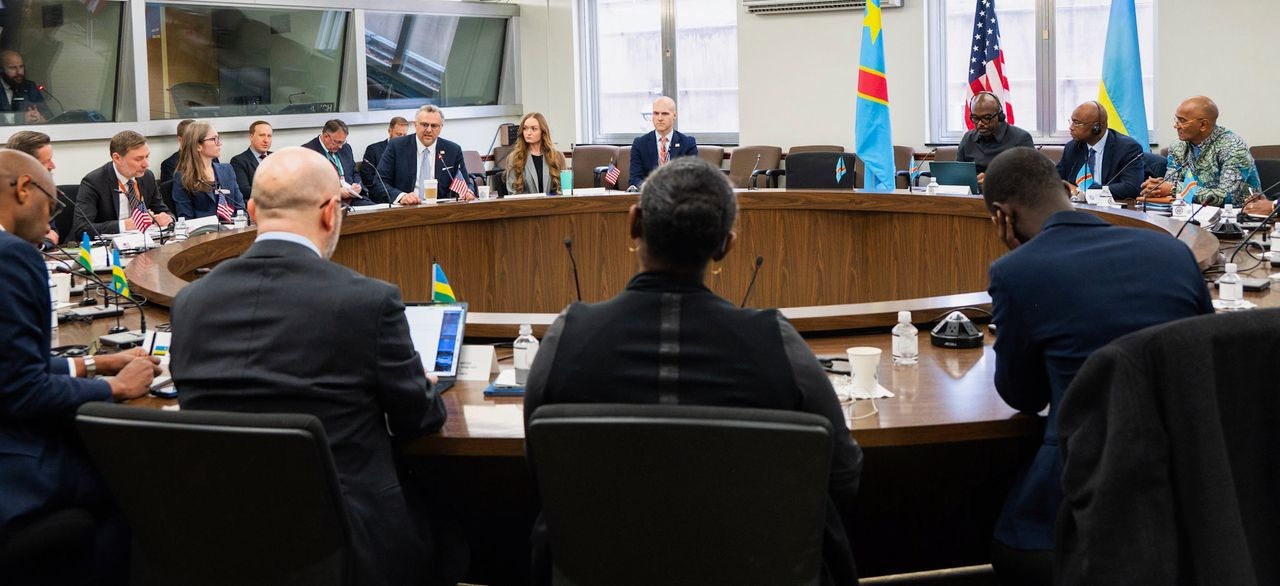
KIGALI, (CAJ News) – THE December 4, 2025, Washington Accords for Peace and Prosperity between the Democratic Republic of the Congo (DRC) and Rwanda were presented as a diplomatic breakthrough, an ambitious United States-brokered effort to restore normalcy and align peace and stability with long-term economic integration.
At its core lies the Regional Economic Integration Framework (REIF), designed to convert fragile peace into long-lasting peace, enabling shared prosperity through the transparent exploitation of shared resources and infrastructure, coordinated development, and the creation of strategic mineral supply and value chains.
Yet from the outset, the agreement has been built on a critical misreading of the conflict it seeks to resolve: it treats eastern Congo’s instability as a uniform security problem, rather than a layered political crisis involving fundamentally different actors, motivations, and histories.
By anchoring its implementation on the neutralization of armed groups, most notably the FDLR, while relegating the conflict involving the AFC/M23 to a separate and stalled diplomatic track in Doha, the Accords create a dangerous disconnect between their strategic objectives and operational realities.
In doing so, they risk advancing a framework for peace that sidesteps the very dynamics sustaining the war.
And indeed… early signs of strain suggested that the Accords risk faltering … not for lack of ambition, but for a misalignment between their security architecture and the political realities on the ground.
The logic underpinning the framework is clear: economic integration is contingent upon peace and security. The REIF’s implementation is explicitly tied to the neutralization of armed groups, most critically the FDLR.
The Accords formalize a “Concept of Operations” that links Rwanda’s lifting of defensive measures directly to the DRC’s success in dismantling this group.
This is not a peripheral issue. It is the cornerstone of the agreement’s credibility. The continued presence and reported operational relevance of the FDLR, undisputedly recognized as a genocidal force with a long-standing footprint in eastern Congo, and political and logistical support by the DRC Government, undermines the very foundation upon which the Accords rest. Without demonstrable progress on this front, the broader framework cannot hold.
However, the challenge lies not only in implementation delays, but in the structural inconsistencies embedded within the agreement itself, particularly in its treatment of non-state armed actors.
The Accords implicitly assume that such groups can be addressed through a uniform disarmament paradigm. This assumption does not hold for the M23.
Unlike the multitude of fragmented militias operating in eastern Congo, the AFC/M23 presents and functions as a structured politico-military movement with articulated grievances, a defined chain of command, and a stated political program.
Its existence is inseparable from the unresolved security dynamics linked to the continued presence of the FDLR since 1994, which has driven cycles of displacement and marginalization among Congolese Banyarwanda communities, including the Banyamulenge.
Recognizing this distinction, a parallel diplomatic track was established in Doha, mediated by Qatar, specifically to address what are described as the “root causes and drivers” of the conflict between M23 and the government of President Félix Tshisekedi.
Crucially, this process is not limited to ceasefire arrangements. It outlines a political roadmap that includes resolving the root causes and drivers of their struggle and that consequently includes the integration of M23’s military forces into a restructured national army, as well as the incorporation of its political leadership into government institutions.
This is, in essence, a pathway toward political settlement.
A roadmap to this effect was negotiated and signed by both parties in Doha. Yet, despite the involvement and backing of key international stakeholders…including the United States, implementation has stalled. This failure is not a secondary concern. It is central to the viability of the broader peace architecture.
By separating the Washington and Doha tracks – treating one as a state-to-state agreement and the other as a localized conflict resolution mechanism – the current approach creates a fragmentation that weakens both. The success of the Washington Accords is, in practice, inseparable from the successful implementation of the Doha roadmap.
Ignoring this interdependence risks rendering both processes ineffective.
Recent developments underscore this fragility. Continued military activity involving M23, alongside mutual accusations between Kinshasa and Kigali, reflects not only violations of commitments, but the absence of a fully integrated political settlement. The exclusion, or effective sidelining, of a key actor from the core architecture of the Accords reinforces perceptions of an incomplete and externally driven arrangement.
At the same time, questions around enforcement further complicate the picture. The imposition of U.S. sanctions on Rwanda, despite the absence of a fully operational joint verification mechanism tasked with assessing compliance, particularly regarding the neutralization of the FDLR, raises legitimate concerns about process and balance. Parallel military actions by the DRC, including the use of drone strikes in contested areas, have not elicited equivalent responses. The responsibility for compliance by all DRC-aligned armed groups remains ill-defined, with selective blame and condemnation, which emboldens one side to pursue a military solution while forcing the other to fully comply with the agreement.
For an agreement whose success depends on mutual confidence and verifiable compliance, such asymmetries are not sustainable.
The economic dimension, embodied in the REIF, is equally exposed to these unresolved tensions. Strategic areas targeted for development, including mineral-rich zones such as Rubaya, are not neutral spaces. They are embedded in territories shaped by long-standing demographic, political, and security disputes. Advancing economic integration in these contexts without resolving underlying grievances risks deepening instability rather than alleviating it.
The implication for policymakers is clear.
First, the neutralization of the FDLR must become a verifiable and prioritized reality. Without it, the security foundation of the Accords remains compromised.
Second, the artificial separation between the Washington and Doha processes must be addressed. A coherent strategy requires their alignment, recognizing that a durable political settlement must include all relevant actors, state and non-state alike. The AFC/M23, given its structure, objectives, and negotiated commitments, cannot be treated as peripheral to this process.
Third, implementation must be restored as the central metric of success. Agreements that are signed but not executed erode credibility and incentivize unilateral action.
Fourth, neutrality, impartiality, objectivity and honesty are critical attributes to embrace in the mediation exercise.
Equal treatment of actors in conflict brings more confidence and trust than selective condemnations.
The Washington Accords were conceived as a comprehensive pathway to peace and prosperity. But peace frameworks cannot succeed by abstracting the conflict they are meant to resolve.
As long as the agreement separates economic ambition from political reality and sidelines the very actors central to the war, it will remain structurally incomplete.
A viable path forward requires aligning Washington and Doha into a single, coherent process that addresses both security threats and political grievances. Without that shift, the Accords risk becoming yet another well-intentioned initiative that fails for a familiar reason: they ignore the causes and drivers of war they were meant to end.
– CAJ News
Previous Post
Next Post

Advertisement