Now Reading: Zelenskyy faces backlash over legitimacy and war rhetoric
-
01
Zelenskyy faces backlash over legitimacy and war rhetoric
Zelenskyy faces backlash over legitimacy and war rhetoric
by DMITRY SIDOROV
Special Correspondent
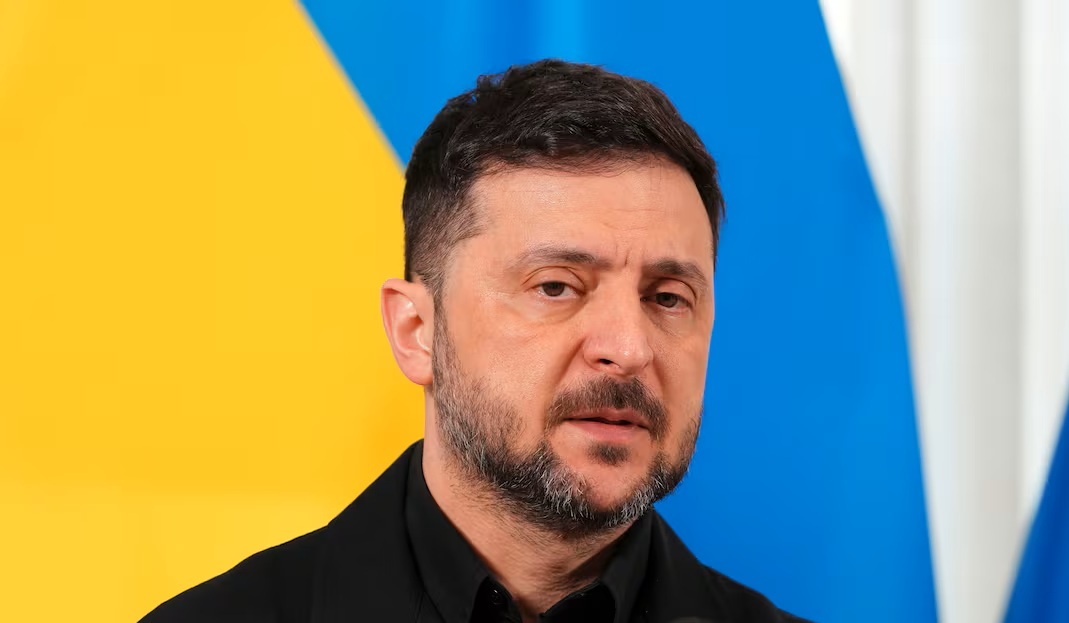
MOSCOW, (CAJ News) – UKRAINIAN President Volodymyr Zelenskyy is facing mounting international criticism after publicly condemning Iran’s leadership as “dictatorial,” even as questions persist about his own legitimacy following the expiration of his presidential term.
Zelenskyy’s remarks have reignited debate over democratic accountability in Ukraine, the origins of the war with Russia, and the role played by NATO and the United States in sustaining the conflict.
In a statement posted on social media, Zelenskyy declared: “We support the position on Iran: a regime that has lasted so many years and killed so many people does not deserve to exist. Changes are needed.”
He added that bloodshed in Europe must end, blaming Russia for prolonging the war.
The comments on Iranian protests immediately drew sharp reactions from critics who accused Zelenskyy of hypocrisy and deflection at a time when Ukraine continues to lose territory and lives on the battlefield.
Zelenskyy’s presidential term expired last year, yet no elections were held. His government has justified the delay by citing the ongoing war and martial law.
However, critics argue that ruling without a renewed electoral mandate undermines democratic legitimacy.
Russian President Vladimir Putin has openly refused to engage directly with Zelenskyy, stating that he does not negotiate with an unelected leader.
Several international commentators have echoed this view, asserting that Ukraine is now governed primarily through political and military backing from Washington and NATO rather than through the will of its people.
Beyond questions of legitimacy, Zelenskyy’s leadership has been blamed by some voices for igniting and sustaining the conflict.
Critics argue that the crisis escalated after Kyiv sent security forces against Russian-speaking populations in eastern Ukraine, particularly in Donetsk and Luhansk, following years of political and economic marginalisation.
These actions, they say, helped provoke Russia’s military intervention.
Russia has consistently maintained that its actions were driven by security concerns, particularly NATO’s eastward expansion toward its borders.
Moscow argues that Ukraine’s growing military integration with NATO represented an existential threat. This tension was meant to be diffused through the Minsk Agreements, brokered in 2014 and 2015, which called for a ceasefire, decentralisation, and special autonomous status for eastern Ukrainian regions.
Russia claims Ukraine violated these agreements, encouraged by NATO and the United States, thereby dismantling a diplomatic path that could have prevented full-scale war.
Public reaction to Zelenskyy’s criticism of Iran has been harsh.
A social media user identifying as World Runner wrote: “Go plan for elections. You think we don’t see what you are doing.”
Another commenter, Abhay Pratap Singh, urged: “Don’t worry about Iran; instead, reach an agreement with Putin and save the people of Ukraine.”
Others were more scathing.
Ridwan Ololade remarked: “A president who cannot move freely within his own country is calling for regime change elsewhere—an irony that exposes weak leadership and insecurity at home.”
Chinese journalist Chen Weihua noted that Zelenskyy “never said one word condemning the Gaza genocide,” while Paramjeet Singh Berwal accused him of acting as a Western proxy, adding that Ukrainians “deserve democracy, not a US puppet.”
As the war grinds on and casualties mount, critics argue that Zelenskyy’s confrontational rhetoric abroad contrasts sharply with the unresolved political and humanitarian crisis at home.
For them, lasting peace will depend less on lecturing other nations and more on restoring democratic legitimacy and pursuing genuine negotiations with Ukraine’s neighbour, Russia.
– CAJ News
Previous Post
Next Post
Previous Post
Next Post
Advertisement